
How to Identify Birds by Song: A Beginner Guide
Published on 5/9/2026 • 9 min read
Birdsong can feel like a wall of sound at first. A robin pours out phrases from a roofline, a wren rattles from deep cover, a chickadee calls from somewhere behind you, and everything overlaps. The good news is that you do not need perfect pitch or a musician’s ear to begin. Most bird identification by sound comes down to noticing a few repeatable clues: rhythm, pitch, tone, habitat, season, and behavior.
This guide gives you a practical way to start listening, make better guesses, and know when to leave an identification uncertain.
Why Bird Songs Matter
Many birds are easier to hear than see. This is especially true in spring, in dense woods, wetlands, grasslands, and city parks with heavy leaf cover. A bird may sing for several minutes while staying hidden in one tree. If you can recognize even a handful of common sounds, the landscape opens up.
It also helps you find birds before you raise binoculars. A thin, rising note from a marsh can point you toward a rail or sparrow. A repeated drumming from a dead branch may reveal a woodpecker. A sharp alarm call can tell you that something has disturbed a flock nearby.
Still, sound identification has limits. Some birds mimic others. Some calls change by region. Young birds can give odd, imperfect sounds. Wind, traffic, water, and distance can distort what you hear. Treat bird song as evidence, not a guaranteed answer.
Song, Call, and Other Sounds
Birders often separate sounds into three broad groups.
Songs
Songs are usually longer and more patterned. They are often used to attract mates or defend territory. In many species, males sing most frequently during the breeding season, especially around dawn and early morning.
Examples of song qualities include:
- Clear whistles
- Buzzing trills
- Warbled phrases
- Repeated notes
- Rising or falling patterns
Calls
Calls are often shorter. Birds use them for contact, alarm, begging, flight, flock movement, and many other purposes. A species may have several calls that sound nothing like its song.
For beginners, calls can be harder than songs because they are brief. But common calls are worth learning because you hear them year-round.
Non-vocal Sounds
Not every bird sound comes from a throat. Woodpeckers drum on trees, gutters, and utility poles. Some grouse create low booming displays. Certain ducks whistle with their wings in flight. Shorebirds may produce wing or tail sounds during display.
When you hear a sound, ask: does it seem vocal, mechanical, or made by movement?
Start With the Big Clues
Before trying to name the species, describe the sound. A rough description is more useful than a rushed guess.
Pitch
Is the sound high, low, or in the middle? Tiny birds often give high, thin notes, though not always. Doves and owls tend to produce lower sounds. Some high-pitched calls are difficult for people to hear clearly, especially with age or background noise.
Try comparing the sound to familiar noises:
- Thin like a squeaky wheel
- Fluty like a whistle
- Harsh like a scold
- Nasal like a toy horn
- Dry like clicking pebbles
Rhythm
Rhythm is one of the best clues. Count the pace if you can.
Does the bird repeat the same note evenly? Does it pause between phrases? Does the song speed up, slow down, or stay level? Is it a trill, a series, or a jumble?
A bird that sings “one-two-three, pause, one-two-three” gives you a stronger pattern than a bird that simply sounds “pretty.”
Tone Quality
Tone is the texture of the sound. Two species may sing at similar pitch, but one sounds sweet and whistled while another sounds buzzy or scratchy.
Listen for these traits:
- Clear
- Buzzy
- Raspy
- Metallic
- Liquid
- Hollow
- Chattery
- Nasal
This part can feel subjective, and that is fine. Your words only need to help you remember and compare.
Pattern and Shape
Many songs have a shape. They may rise, fall, alternate, or repeat. Some begin with a few slow notes and end in a trill. Others start sharp and then tumble into messy phrases.
If you can, sketch the sound in words:
- “Three clear whistles, then a fast trill”
- “Single high chip every few seconds”
- “Buzzy note that rises at the end”
- “Loose warble with no repeated phrase”
These notes are often enough to narrow your options later.
Use Habitat and Season
A bird sound never happens in isolation. Where and when you hear it matters.
Habitat
Different birds favor different places. A loud song from cattails suggests a different list than a loud song from a spruce forest. Before opening an app or field guide, look around.
Ask:
- Are you in woods, scrub, grassland, wetland, shore, desert, or a neighborhood?
- Is the bird high in the canopy, near the ground, over water, or in reeds?
- Are there dead trees, dense shrubs, open fields, or conifers nearby?
Habitat will not identify the bird by itself, but it can rule out many poor matches.
Season
Bird vocal behavior changes through the year. Spring and early summer bring the most territorial song in many regions. Fall may feature contact calls from migrating birds. Winter flocks are often quieter but still give chips, whistles, and alarms.
Be cautious with out-of-season songs. Some species sing on warm winter days, and some migrants pass through quietly. But if a match seems very unlikely for your region and date, look for a more common explanation first.
Watch the Bird If You Can
Sound and sight together are much stronger than either alone. Once you hear a sound, pause before moving. Birds often reveal themselves by posture, movement, or repeated singing perches.
Look for:
- A bird opening its bill in time with the sound
- Tail flicking, wing drooping, or body bobbing
- A consistent perch used between phrases
- Movement in the exact direction of the sound
Be careful with direction. Sound bounces off buildings, cliffs, tree trunks, and water. A loud song can seem close when the bird is farther away. A soft call can seem to come from the wrong side of a trail.
If you are new to visual identification too, pair listening with a beginner field approach like the one in Bird Lens’s beginner bird identifier guide.
Record Short Audio Notes
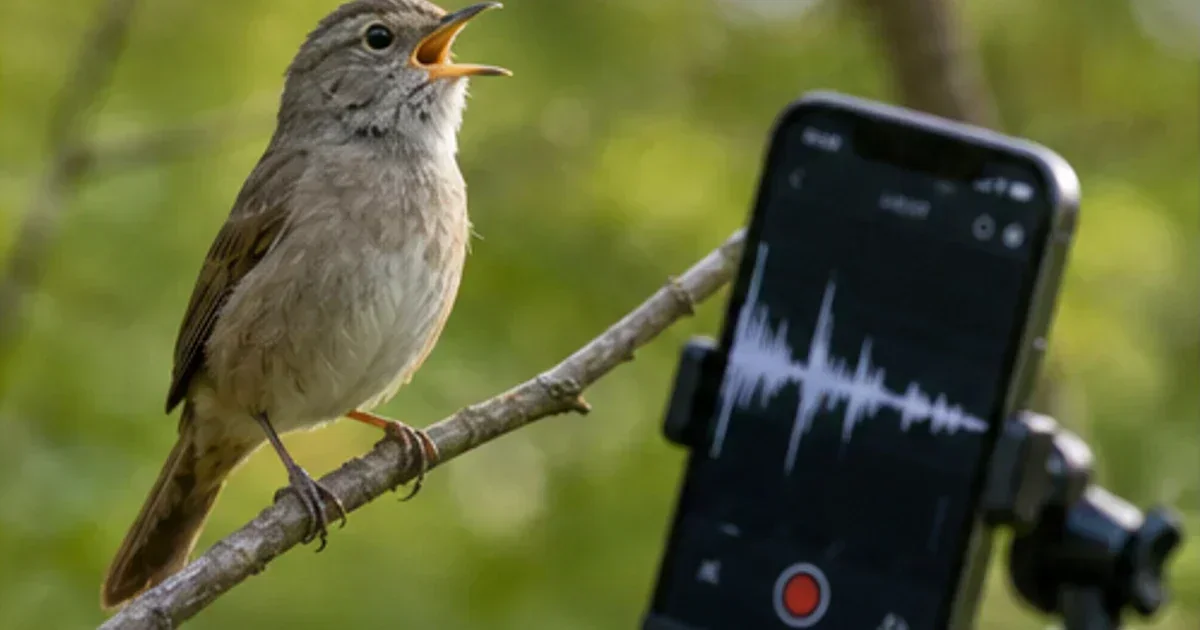
A short recording can help you study later, especially if the bird stops before you identify it. You do not need studio-quality sound. Even a phone recording may capture rhythm and tone well enough for comparison.
Try this:
- Stand still and avoid rustling clothing.
- Point the microphone toward the bird if you know the direction.
- Record 20–30 seconds, including pauses.
- Say the location, habitat, and your first impression after the bird stops.
- Keep the original recording if possible.
If you use a sound-identification tool, treat the result as a suggestion. Compare it with your own notes, range, habitat, and season. Bird Lens offers a dedicated sound ID tool that can be useful when paired with careful listening rather than used as a final verdict.
Learn a Small Local Set First
Trying to learn every bird song at once is frustrating. Start with the most common voices in your area. Once those become familiar, unfamiliar sounds stand out.
A good starter set might include:
- American Robin or your local thrush
- Chickadee, tit, or similar common flocking bird
- Wren
- Sparrow
- Dove or pigeon
- Crow, raven, or jay
- Woodpecker
- A common blackbird, starling, or grackle
- A local warbler or finch
The exact list depends on where you live. The point is to anchor your ear. When you know the regular neighborhood sounds, you can say, “That is not the usual robin,” which is a real step forward.
For broader field skills that support sound ID, browse the practical birding advice in Bird Lens tips.
Compare Similar Sounds Carefully
Many mistakes happen when two birds share one obvious feature. A beginner may hear “buzzy” and jump to one species, or hear “high and sweet” and assume another. Slow down and compare the details.
Use a four-part check:
1. Is the rhythm right?
If your candidate species usually gives paired notes, but your bird repeats single notes, be skeptical.
2. Is the habitat right?
A woodland bird can wander, but a match that ignores habitat needs stronger evidence.
3. Is the date reasonable?
Migration can produce surprises. Even so, common seasonal birds are more likely than rare out-of-range ones.
4. Did you hear enough?
One chip note may not be enough. A full phrase repeated several times is far better.
It is perfectly acceptable to write “unknown sparrow,” “possible wren,” or “high chip from shrubs.” Good birding includes restraint.
A Short Field Checklist
Use this quick checklist when you hear an unfamiliar bird:
- Stop and listen before moving.
- Describe the sound: pitch, rhythm, tone, and pattern.
- Note the habitat: trees, shrubs, water, grass, buildings, or open ground.
- Check the season and time of day.
- Watch for the singer: bill movement, posture, repeated perch.
- Record a short clip if possible.
- Compare likely local species first.
- Mark uncertain IDs as uncertain.
- Avoid disturbing the bird to get a better look or recording.
Ethical Bird Listening
Sound can be intrusive if used carelessly. Playback—the practice of playing recorded bird sounds to draw birds closer—can stress birds, especially during breeding season or in heavily birded areas. Some parks and reserves prohibit it.
For beginner birding, the simplest rule is best: listen more than you broadcast. Do not play songs near nests. Do not lure rare birds for a photo. Keep distance from owls, nesting birds, and sensitive species. If a bird changes behavior because of you—scolding, approaching repeatedly, leaving a nest area, or showing agitation—back away.
Recordings made passively are usually low-impact. Moving quietly, staying on trails where required, and accepting an imperfect view are all part of responsible observation.
When to Use Photo ID Alongside Sound
Sometimes you hear a bird, then catch only a brief glimpse: a wing bar, a yellow throat, a long tail, a heavy bill. Those visual clues can confirm or challenge what you heard. If you get a photo, even a poor one, compare it with the sound evidence. A blurry image may still show size, shape, color patches, and posture.
You can pair your notes with Bird Lens’s photo ID tool when you have an image, but use the same caution: one clue rarely settles everything. The strongest identifications come from several clues pointing in the same direction.
Conclusion
Learning bird songs is less about memorizing a huge library and more about building attention. Notice pitch, rhythm, tone, and pattern. Add habitat, season, and behavior. Record short clips when useful, and let uncertainty remain when the evidence is thin.
Start with the familiar birds around your home or local patch. Their voices will become landmarks. Over time, the background noise turns into individual birds, each with its own place in the morning chorus.
Try the tools
Put this advice into action
Use Bird Lens to identify a bird by photo or sound, then compare field marks and habitat.
Photo Bird ID
Upload a bird photo for AI-assisted species identification with encyclopedia links.
Sound Bird ID
Record bird songs and calls to get likely species matches from your audio capture.
Field Notes Bird ID
Identify likely birds from field marks, habitat, behavior, place, and date.
Similar Species Comparison
Compare two easily confused bird species using diagnostic field marks.
Beginner bird identifier guide: from first sighting to confident identification
Beginner bird identifier guide: from first sighting to confident identification: practical, field-tested guidance for identifying and observing birds with confidence.